

Trump would sign clean marijuana descheduling bill, adviser says
A senior adviser says Trump would back removing marijuana from federal drug law but would likely veto the MORE Act, as Democrats prepare to take Congress.
Produced by MetaFlora's AI newsroom from the sources listed at the end of this article. How we report
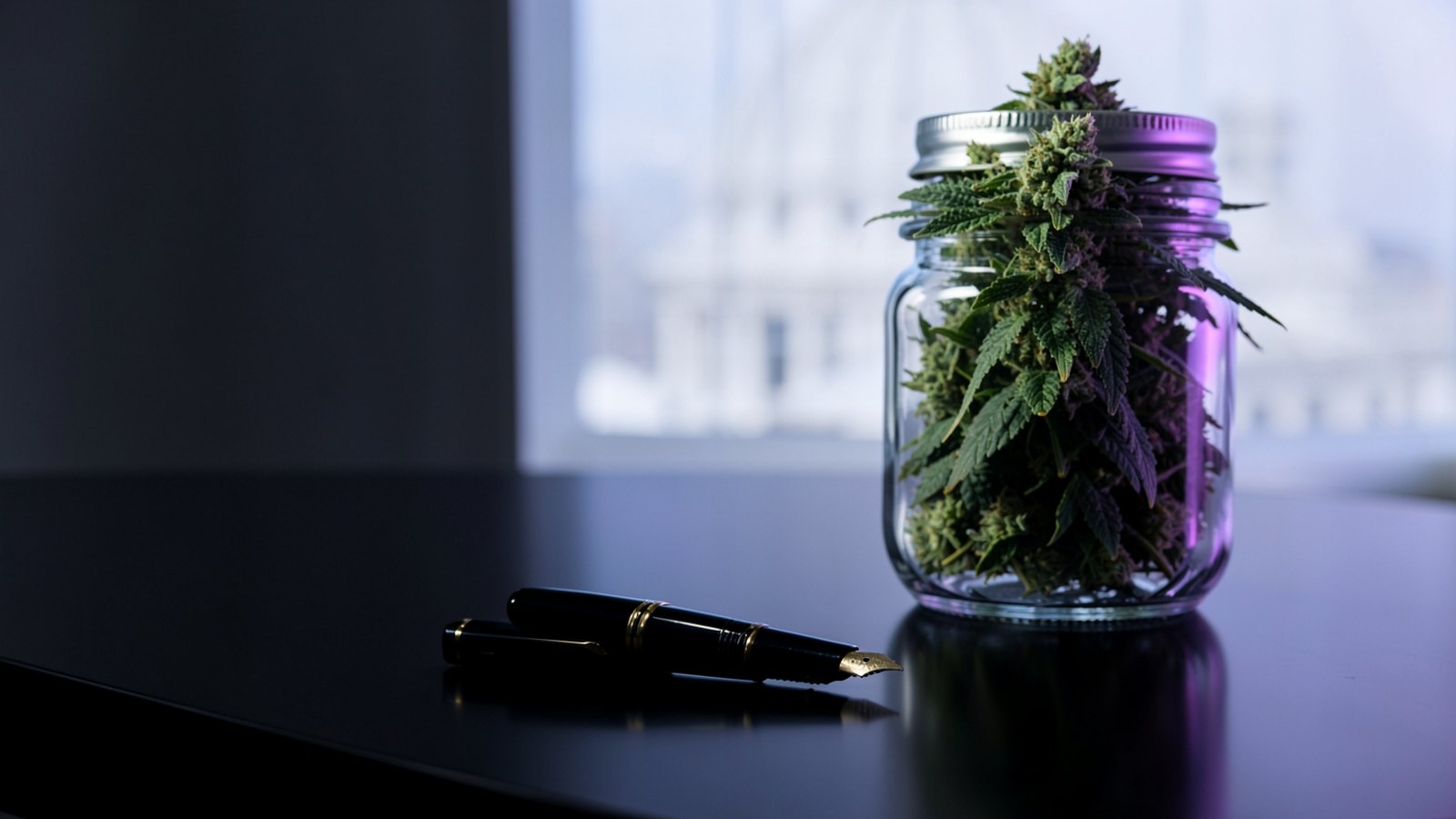
Two days after Democrats won control of both chambers of Congress, the clearest signal yet on how federal marijuana prohibition could end came from inside the Trump camp. A senior adviser to President Donald Trump told The Marijuana Herald on 5 November that the president would sign legislation removing marijuana entirely from the Controlled Substances Act, provided Democrats send him a narrow, stand-alone descheduling bill.
The offer comes with a hard edge. According to the same adviser, Trump would likely veto the Marijuana Opportunity Reinvestment and Expungement (MORE) Act or any similar package that pairs descheduling with additional programs, especially social equity provisions. The adviser spoke on condition of anonymity; the Herald said it had independently verified the person's position.
What the adviser is offering
Descheduling is a bigger step than the rescheduling the administration has pursued so far. Moving marijuana to Schedule III keeps it a controlled substance under DEA authority; removing it from the schedules altogether would end federal prohibition and leave each state free to allow, regulate or ban cannabis as it chooses.
The MORE Act, sponsored in the House by Rep. Jerrold Nadler (D-NY), does more than that. It would also expunge certain federal marijuana convictions, fund programs for communities hit hardest by enforcement and impose a federal tax on cannabis products to pay for them. The bill has passed the full House before but has never received a Senate vote. The adviser's message is that the descheduling core is acceptable to Trump and the add-ons are not.
The source has a mixed but notable track record with the Herald. The outlet reported in March that Trump was weighing the removal of Attorney General Pam Bondi, who was dismissed on 2 April, and that Trump wanted acting Attorney General Todd Blanche to press ahead with rescheduling; Blanche signed the order moving state-licensed medical marijuana to Schedule III on 22 April. A prediction that Trump would create a federal descheduling commission before the midterms has not come true. The adviser told the Herald that the commission is still intended once rescheduling is completed.
The new arithmetic in Congress
Democrats regained the House and the Senate in the 3 November midterms. As of the morning after the vote, Marijuana Moment reported a Senate majority of somewhere between 54 and 56 seats, with two races still uncalled. The 120th Congress convenes in January.
A Democratic House has passed federal legalization twice before, most recently in 2022. The Senate is the harder chamber: most legislation needs 60 votes to overcome a filibuster, and even the narrow, broadly bipartisan banking bill never cleared that bar. Any descheduling bill would therefore need several Republican senators, and the president's signature or a veto-proof majority.
The likely leaders of the new Congress have been on this ground before. Expected House Speaker Hakeem Jeffries and Senate Majority Leader Chuck Schumer partnered in 2019 on the Marijuana Freedom and Opportunity Act, a descheduling bill. Schumer later backed a broader legalization and regulation bill, the Cannabis Administration and Opportunity Act, while Jeffries worked with a Republican colleague on a proposal for a federal commission to design an alcohol-style regulatory system. Marijuana Moment has also reported that cannabis executives donated to Jeffries's joint fundraising committee.
The question for 2027 is no longer whether Washington will move on marijuana, but how much Democrats are willing to leave out of the bill to get a signature.
How reformers are responding
Rep. Dina Titus (D-NV), a co-chair of the Congressional Cannabis Caucus, told the Herald that the obvious first step is to fix the federal government's scheduling of marijuana and that she is committed to a bipartisan solution with Congress and the administration. She did not say whether she would support a bill without social equity provisions. Titus has backed the MORE Act in the past and, in late October, endorsed a separate bill from Rep. Steve Cohen (D-TN) that would deschedule marijuana and overhaul federal drug sentencing.
Rep. David Joyce (R-OH), another caucus co-chair, told the Herald that rescheduling should be paired with legislation on banking access, states' rights and federal regulation, and that he is ready to work with both parties and the White House. He, too, sidestepped the question of a stripped-down bill.
Roger Stone, the Republican operative who has advised Trump for decades, told Marijuana Moment he would urge the president to sign whatever cannabis bill the Democratic Congress sends, saying he wants to see whether Democrats will now "decriminalize marijuana at a minimum and deschedule at a maximum." Sen.-elect James Talarico (D-TX) said he agrees with the president on the need to legalize marijuana.
Advocacy groups are pulling in different directions. NORML's political director, Morgan Fox, told Marijuana Moment that Schedule III changes little for consumers and that Congress should deschedule. The Drug Policy Alliance's Cat Packer argued that rescheduling is not enough and that reform should not mainly benefit large, politically connected companies, a position that sits uneasily with a bill stripped of equity measures. The National Cannabis Industry Association pointed to more than $29 billion in annual legal sales and over 400,000 jobs and asked for action on banking, capital and taxes.
Where rescheduling stands
None of this replaces the administrative track already running. Blanche's April order moved state-licensed medical marijuana into Schedule III, and the DEA has begun registering medical dispensaries, as we reported on 6 November. Adult-use marijuana remains in Schedule I while DEA Chief Administrative Law Judge Derek Julius considers broader rescheduling; final responses on a Government Accountability Office report were due on 5 November, and no deadline has been set for his recommendation. The adviser told the Herald last week that Trump is confident DEA Administrator Terrance Cole will finalize rescheduling quickly once it reaches him. The April order also faces a challenge in the U.S. Court of Appeals for the D.C. Circuit.
What to watch
The first test comes when the new Congress convenes in January and Democratic leaders choose which cannabis bill to put forward: a narrow descheduling measure, a revived MORE Act or a broader regulatory bill. Watch for Republican senators willing to co-sponsor, for any on-the-record statement from the White House, which so far has spoken only through an unnamed adviser, and for the administrative judge's recommendation on Schedule III. Closer in, the challengers' opening brief in the D.C. Circuit case is proposed for 24 November.
Sources
- The Marijuana Herald (Trump adviser)
- The Marijuana Herald (Titus)
- The Marijuana Herald (Joyce)
- The Marijuana Herald (rescheduling timeline)
- Marijuana Moment (Titus and Stone)
- Marijuana Moment (new majorities)
- MetaFlora News
This article summarises and links the original reporting. Spotted an error? Email support@metaflora.xyz or message @MetaFloraLabs on X.

